Is Language a Communication Problem in Singapore Workplaces?
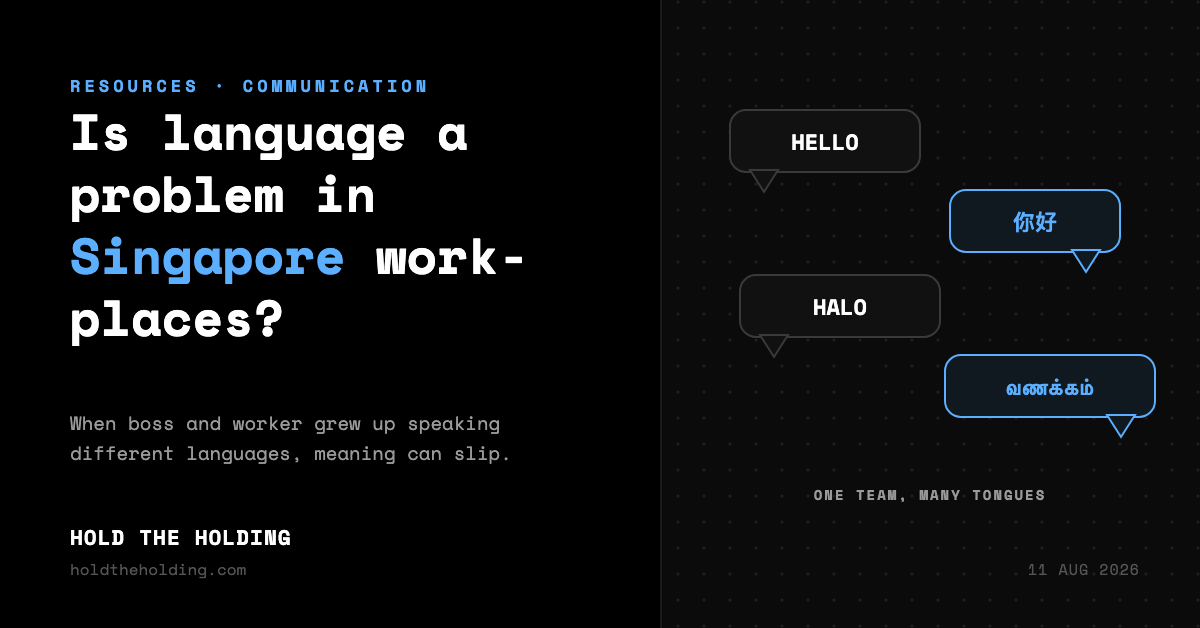
The short answer: often, yes, and it is rarely anyone's fault. In many Singapore companies, the boss and the worker did not grow up speaking the same language. English bridges most of the distance, but for many people on both sides of the conversation it is a second or third language. Instructions make the crossing mostly intact. "Mostly" is the expensive part.
Where the gap actually shows up
Rarely in the big things. The gap lives in everyday exchanges between people who each use the shared language a little differently. A boss explains a task the way they would phrase it in their own language, and the worker hears it through theirs. "Clean the machine before you go" means a full washdown to one person and a quick wipe to another, and both walk away sure they understood each other. A briefing delivered at speed, a new SOP explained once, an "any questions?" met with silence. That silence is human, not careless. It takes confidence to ask a question in front of the whole team, so people sensibly fill the gaps by watching a colleague instead. Most of the time that works well. Occasionally it does not, and what gets logged as a careless mistake is often just an instruction that never fully arrived.
Why this lands hardest on SMEs
Large companies hire trainers and translate their materials. An SME typically has one version of everything, written in English by whoever had time, and that is not a criticism: nobody has spare hours to translate SOPs. The result is simply a mismatch. The businesses with the most multilingual workforces often end up with the most monolingual training, by bandwidth rather than by choice.
What actually works
- Show, don't just tell. A video of the task itself crosses language lines in a way a memo never will.
- Localise the words that remain. Subtitles or narration in the worker's own language cost little and change everything about comprehension.
- Check understanding without shame. A private quiz lets a worker fail, rewatch and pass, without doing it in front of the team.
A worker who fully understands the job in their own language assimilates faster, works safer, and delivers their best work sooner. That is not a language programme, it is just good operations. It is also one of the main reasons we built our LMS with language localisation from day one.
Train your team the way people actually learn. Our Learning Management System turns your onboarding and training into short videos with quizzes, localised into the languages your workers speak, running on a server in your own office. One-time setup at S$5,000. Reach out at admin@holdtheholding.com.